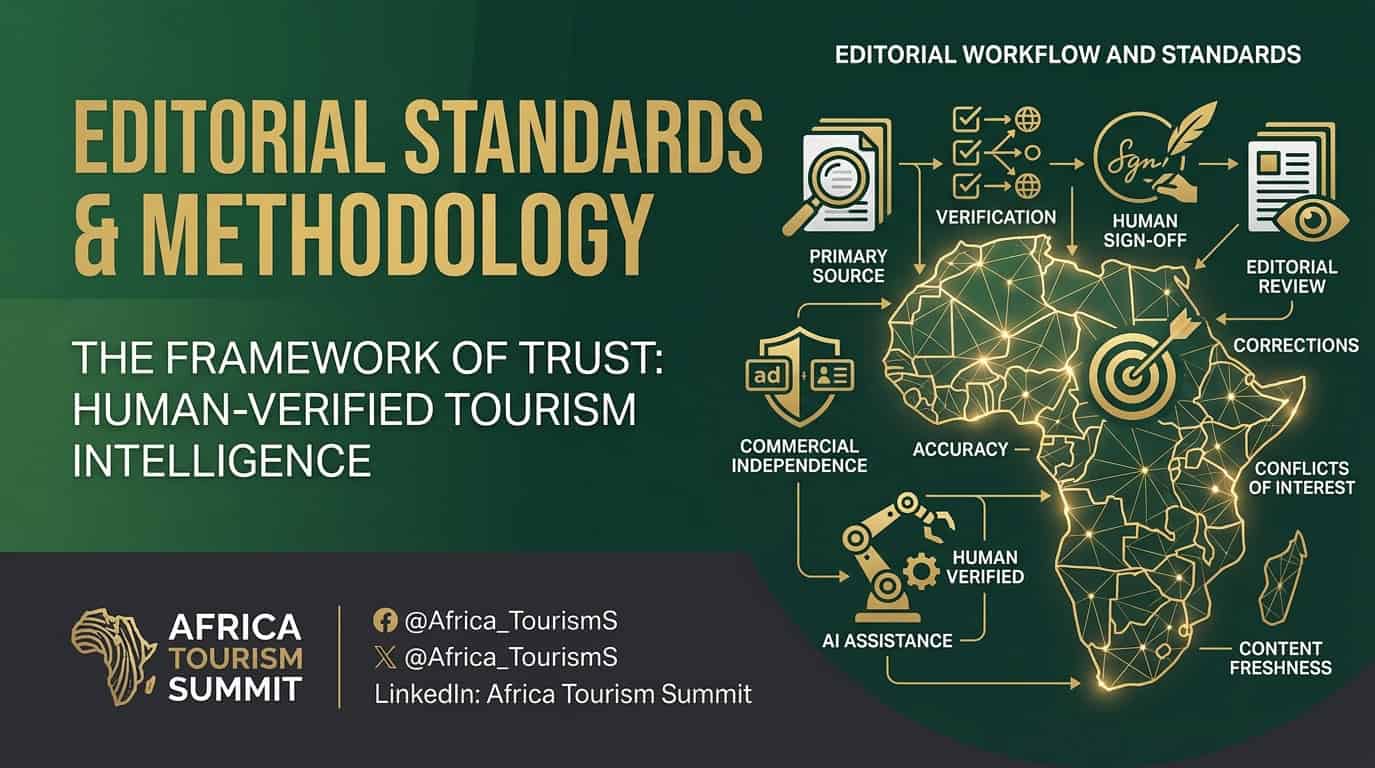
Every claim on this platform is checked against a primary source before it goes live, and a human editor signs off on every published word, including the ones AI tools helped draft. This page is the complete methodology behind that, not a marketing statement about “trust.” If you’re deciding whether to cite us, partner with us, or simply take a story at face value, this is where you check our work.
Jump to a section: 1. Editorial Mission · 2. Accuracy, Sources & Original Reporting · 3. Corrections · 4. Editorial Independence · 5. Conflicts of Interest · 6. Contributors, Licensing & Attribution · 7. AI-Assisted Research & Production · 8. Sponsored Content & Advertising Separation · 9. Accountability · 10. Content Freshness & Update Policy · Frequently Asked Questions
Effective Date: August 14, 2026 · Last Updated: August 27, 2026
1. Editorial Mission
We publish tourism investment intelligence, not tourism promotion. Every story is built to answer one question: what is changing in a market, and what does that change mean for someone about to deploy capital, write policy, or build infrastructure? A story that only informs, without giving the reader something they can act on, gets sent back before publication, not because it’s factually wrong, but because it’s incomplete by our standard.
2. Accuracy, Sources & Original Reporting
We prioritise primary sources, regulatory filings, official government data, institutional reports, direct interviews, and credible industry publications, over secondary aggregation. Where a claim involves a specific figure, date, or deal detail, it is checked against at least one primary source before publication. Where sourcing is thin or contested, we say so explicitly in the piece rather than presenting an uncertain claim as settled fact.
We do not publish sensationalist framing, unverified rumour, defamatory material, guaranteed financial claims, or political propaganda. Analysis and prediction are clearly framed as analysis, we tell you when we’re reporting what happened versus when we’re forecasting what might happen next.
3. Corrections
Where a factual error is identified after publication, we correct it and note the correction transparently at the point of the error, with a timestamp, we do not silently edit a published claim. Report a suspected error through Contact, Editorial with the specific claim and your source; we investigate every submission.
4. Editorial Independence
Editorial decisions, what we cover, how we frame it, and what conclusions we draw, are made independently of sponsors, advertisers, and event partners. A partner’s commercial relationship with us does not buy favourable coverage, does not grant editorial veto, and does not determine which stories get written. Full detail on how that separation holds up around paid content sits in Sponsored & Commercial Content.
5. Conflicts of Interest
Editors and contributors disclose any financial, advisory, or institutional relationship connected to a topic they’re covering. Where an undisclosed conflict is identified after publication, the affected material is reviewed and, where necessary, withdrawn or amended with a public note explaining why.
6. Contributors, Licensing & Attribution
We welcome contributions from qualified professionals. Every contribution is governed by these terms and, where applicable, a specific written agreement, these terms apply by default whenever no separate signed agreement exists or is silent on a point below.
Grant of Rights. By submitting a piece for publication, you grant Africa Tourism Summit an exclusive, worldwide, royalty-free license to publish, edit, adapt, distribute, promote, and archive the work indefinitely, including the right to syndicate it across DelzGlobal properties. This is an exclusive license, not a full transfer of copyright, you retain underlying ownership, but you agree not to exercise competing publication rights as set out below.
Exclusivity Window. For 90 days from first publication, the piece, and any substantially similar version of the same story, data, or analysis, may not be published, syndicated, or repurposed on any competing platform, personal blog, or social channel without our written consent. After 90 days, you may republish elsewhere provided our platform is credited as the original publisher with a link back to the original piece. This window protects the distribution and search equity we invest in a story on your behalf; sharing the same reporting with a competitor inside that window is treated as a material breach.
Editorial Control. We reserve the right to edit, condense, rewrite, restructure, or otherwise adapt any contribution to meet our editorial standards, house style, and factual verification requirements, with or without providing the contributor an opportunity to review changes before publication, except where a separate agreement specifically grants review rights. We also reserve the right to decline to publish, to delay publication, or to remove published material where we determine it is factually inaccurate, legally exposed, or in breach of these terms, removal for these reasons does not constitute a breach of our obligations to you and does not itself entitle you to additional compensation.
Moral Rights. To the extent permitted by applicable law, you waive any moral rights that would otherwise restrict our ability to edit, adapt, or contextualise your work as described above. Where such rights cannot be waived under the law that applies to you, we will credit you as the contributing author in a form consistent with your original submission.
Compensation Is Final at Agreement. Where compensation is agreed for a contribution, flat fee, revenue share, or otherwise, that arrangement is fixed at the time of agreement and is not subject to renegotiation based on a piece’s later performance, traffic, or conversion outcomes, unless a separate written agreement specifically provides for performance-based payment. A request for additional payment based on a published piece’s success, made outside an existing performance-based agreement, is not a right under these terms.
Conduct & Non-Disparagement. Disputes regarding payment, credit, or editorial treatment must be raised through Contact, Editorial before any public statement is made. Making false public claims about non-payment, unauthorised deletion, or misrepresentation of a contribution, where our records show otherwise, is treated as a breach of this agreement and may be addressed through correction, public clarification of the record, and, where damages result from a false claim, legal action for defamation or breach of contract.
Breach & Remedies. Where a contributor breaches the exclusivity window, submits plagiarised or unattributed material, or engages in the conduct described above, we reserve the right to remove the contribution, terminate the contributor relationship, withhold or reclaim any unpaid or future compensation connected to the breach, and pursue damages where the breach causes demonstrable harm, including reputational harm addressed through corrective public statement and, where appropriate, formal legal action.
We maintain zero tolerance for plagiarism. We do not publish copied, scraped, or unattributed content, and violations result in immediate removal and termination of any contributor relationship. Where we quote or reference third-party reporting, that source is credited directly in the piece. Full intellectual property and reproduction terms for our own published material live in Terms of Use, Intellectual Property.
7. AI-Assisted Research & Production
Artificial intelligence is a tool here, not an author. We use AI to assist with structuring drafts, summarising research, refining language, and organising data, the same way a research assistant would support a reporter. It does not independently decide what gets published, and it does not replace the editorial review every piece goes through before it goes live.
What AI does not do on this platform: it does not fabricate interviews, invent data or statistics, impersonate individuals, generate deceptive content, or produce a published piece without human review. Where AI-generated visuals are used, they will not misrepresent real events, simulate real participants without consent, or distort factual reporting.
Human oversight applies to every piece, whether AI assisted in drafting it or not: verification against sources, evaluation for context and bias, and a human editor’s sign-off before publication. We do not publish unreviewed, mass-generated, or unverified content, from AI or from any other source.
Responsibility for everything we publish sits with us, not with the tools we used to help produce it.
8. Sponsored Content & Advertising Separation
Where content is sponsored, commissioned, or produced in partnership with an advertiser, it is clearly labelled, “Sponsored,” “Partner Content,” or “In Collaboration With”, visibly and unambiguously, not in fine print. We do not publish paid content disguised as independent editorial reporting, and sponsors do not receive the right to review, approve, or retroactively alter editorial material connected to their sponsorship.
Affiliate links appearing in Shop listings or editorial content are disclosed at the point they appear. Where an affiliate product is fulfilled by a third party rather than us directly, that relationship, and the fact that we may earn a commission, is stated plainly, and the third party’s own terms govern that specific transaction; see Terms of Use, Category C for how that’s handled.
We reserve the right to decline any advertising or sponsorship that contains misleading claims, promotes unlawful activity, infringes intellectual property, or conflicts with the standards on this page, regardless of the revenue involved. Advertising formats we may run (display, native, newsletter sponsorship, event sponsorship) all comply with the advertising network policies we operate under, including Google AdSense and Ad Manager requirements, disclosed in full in our Privacy Policy, Cookies & Advertising.
9. Accountability
We hold full editorial responsibility for everything published on this platform, whether it was written entirely by a human, assisted by AI, or contributed by an outside expert. That responsibility is not outsourced to a tool, a contributor agreement, or a sponsor relationship. If you believe we’ve gotten something wrong, tell us, we investigate every report.
10. Content Freshness & Update Policy
Intelligence decays. A market analysis from twelve months ago may still be readable, but it is no longer current. We review published content on a rolling basis: market analysis and deal coverage is refreshed quarterly; policy and regulatory guides are refreshed biannually; foundational frameworks and methodology pages are reviewed annually. Where a published piece is superseded by new events, we add an inline update note with a timestamp rather than silently rewriting history. Where the core premise of a story has been invalidated by subsequent developments, we publish a follow-up piece and link both ways, we do not pretend the original analysis never existed.
Frequently Asked Questions
Does AI write your articles?
AI tools assist with research structuring, data summarization, and language refinement, but every published word is reviewed and signed off by a human editor. We do not publish unreviewed AI output, and AI does not independently select what gets published, see Section 7 for the full AI-use policy.
How do you handle anonymous sources?
Anonymous sourcing is used sparingly and only when a source’s safety, employment, or contractual position would be put at risk by attribution. Any anonymous claim must be corroborated by at least one additional on-record source or verifiable documentary evidence before publication, we do not run an anonymous claim standing alone.
What happens if a sponsor or partner disagrees with an article about them?
They can request a correction through the same process any reader can, see Section 3, Corrections. Sponsorship or partnership status does not grant editorial veto, pre-publication review rights, or the ability to have coverage altered or withdrawn; see Section 8 for the full commercial-independence policy.
Follow Our Coverage
Facebook · X · LinkedIn · YouTube · RSS Feed